
Lost in Vocalization
Adventures and misadventures in listening

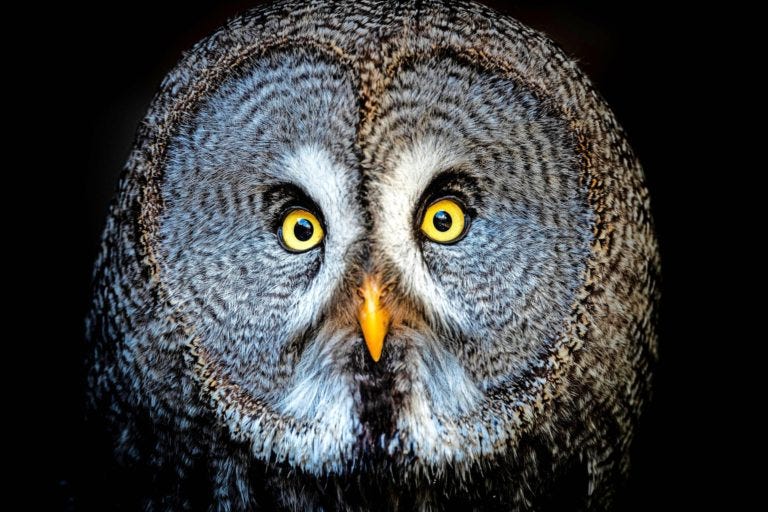
1. In nature the act of listening is primarily a survival strategy. More intense than hearing, listening is a proactive tool, affording animals a skill with which to detect predators nearby (defense mechanism), but also for predators to detect the presence and location of prey (offense mechanism).
My favorite listener of all time (FLOAT) is a predator, the magnificent great grey owl (Strix nebulosa), whose gorgeous fifty-shades-of-grey plumage serves as a soundproofing puffer coat over a surprisingly diminutive body, making the creature both the world’s largest owl in length and one of its lightest in weight.
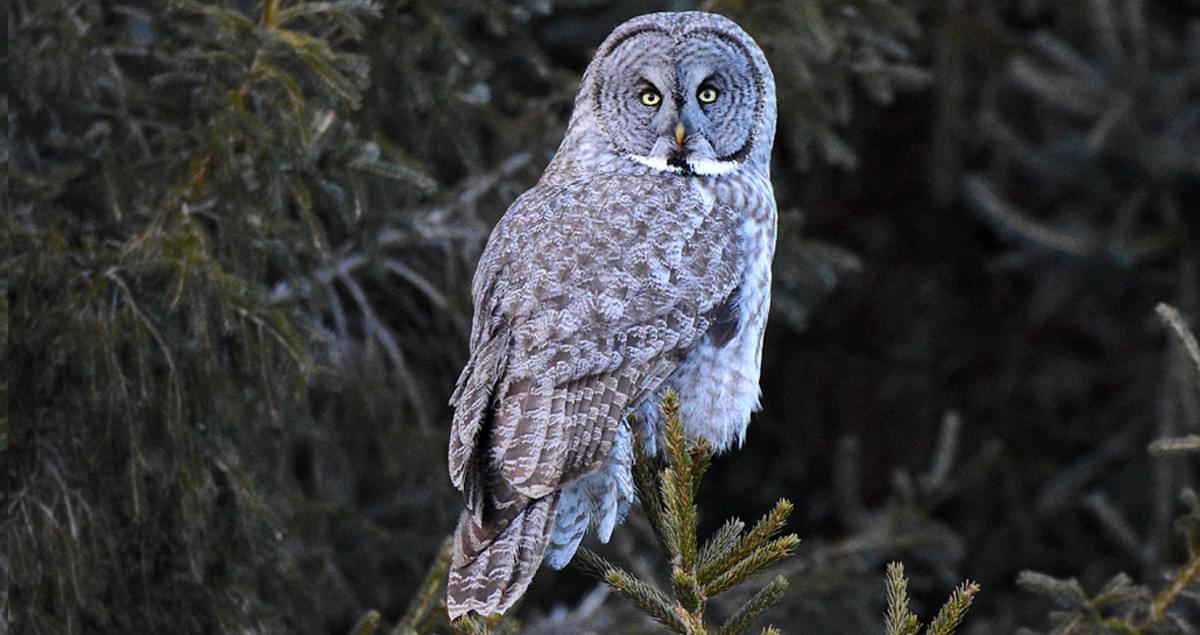
That sweet funny face serves a practical purpose beyond irresistible charm. What happens up there in the frozen arctic latitudes where the great grey owl lives is a match between two well-equipped, cunning adversaries—both good listeners—the owl high up in a tree and the vole deep under a blanket of snow.
If evolution were music, this owl’s hunting technique would be one of nature’s greatest hits, a masterpiece of carefully designed and calibrated physical traits functioning in sync like an orchestra—to enable the owl to hear, locate and capture the unseen vole under two feet of snow from up to a hundred feet away.
From its perch in a tree the owl hears and pinpoints the sound of a vole tunneling its way through the snow cover. Along a series of erratic flight patterns, the owl glides down toward the vole’s coordinates beneath the snow, to a tiny radius of accuracy directly over the vole (who also happens to have a fine set of ears).
To maintain the silence necessary to carry out its surprise attack, the owl’s evolution has provided it with a mass of tiny hairs between the feathers, which muffle any whooshes that might give it away, especially as it hovers over the target.
The clownish circular face, slightly concave like a satellite dish, is filled with small hairs that guide the sound toward the ears. The ears are asymmetrically placed, so that the owl has been able to locate the vole through soundwave triangulation, not unlike how mobile phones are located via their signals to antenna masts.
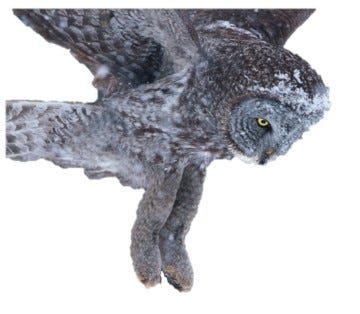
At last, the owl unfolds those claws at the end of its stretched-out, extra-long, fur-covered Jessica Rabbit legs and plunges them straight down into the snow, with enough thrust to break through crust that could hold the weight of a human adult—down to where the vole, if it hasn’t already fled, will meet its fate. There is no room for error. Any deviation from the coordinates annuls the calculation. Not surprisingly, owls often miss. For the strangest coda of all, the vole is usually eaten in one gulp—a safeguard against nearby ravens looking to steal something.
What is surely music to the owl’s ears, can never be heard by the human ear. But the entire process, a tour de force of natural genetic engineering, is as stunning as music.
2. For humans too, listening is still a survival strategy. Every newborn lands in the world unable to understand a word we’re saying. So begins a phase of intense listening—to the tone of voice and its range of emotions, to months of vowels, consonants and inflections, and finally to meanings. First up, ‘Mama’. The capacity of the infant brain allows this breakthrough to a whole new world of communication to occur within a relatively short time. Once an infant has acquired language, some of those listening skills will retire, no longer needed.
I went through this process twice, once as an infant, and shortly thereafter at age three when my family moved to France. As it had before, intense listening to the entire range of foreign expression, verbal and inflective, soon cracked open that second language—a requisite to survive in the new environment.
3. While human beings still retain aspects of intense listening to detect danger—footsteps behind us on a dark deserted street at night, or creaking stairs—our listening has evolved mostly as a pathway to communication (spoken language) and aesthetic pleasure (music and ASMR). We find joy in music, but it is the spoken word that guides us through the social maze of our co-existence.
In the past hundred years, the speaking voice has been given a medium of its own in the form of radio (the analog era) and podcasts (the present digital age), which have exploded in popularity, due in part to their convenience and their ability to paper over the pauses in our lives with chatter.
I have never been able to get through a single podcast. In the shallows of my subconscious, there’s a metronome waving its arm to regulate the tempo of my consumption of ideas. The metronome wants me to learn quickly (or not at all), which is not possible at the snail’s pace of the human voice in a podcast.
Something in me resists the deceleration of time to accommodate the vocalization of an idea—especially when that idea can be conveyed faster and more efficiently through reading.
Because of our new obsession with the sound-recorded versions of all forms of text, the delivery of ideas and information has become protracted. What can be read in five minutes, can now also be listened to in fifteen (But why?).
Whether it’s magazine articles, audio books, or podcasts—everything takes so much longer when it’s delivered by voices. A video interview may also be slow, but at least it offers things to look at—facial expressions, attitude, location, charts—engaging the eye as well as the ear.
In the time it takes a disembodied expert in a podcast to elucidate his theories, I can learn much more about those theories by reading about them.
I have no patience for the endless intros to episodes that seem half over by the time every credit has been covered, or the anemic music lead-ins, or the interminable small talk before getting down to the pith, or the slow talkers, or the fake congeniality between interlocutors. I find myself muttering, ‘Get on with it’’ before closing the link in frustration.
A counter-argument could be posed that in podcasts with two or more participants discussing an issue, a variety of opinions (and hopefully some witticisms) will lead to better understanding of a subject without having to become an expert on one’s own. Fine, send me the transcript.
The stretching of time to accommodate voices can also distort a piece of writing. A case in point is Rebecca Mead’s New Yorker profile of Lady Glenconnor, especially the opening few paragraphs detailing the many splendors of Holkham Hall, the lavish estate where Lady G grew up.
Mead’s writing here is descriptive and neutral, setting the stage for the rest of the article. In the recorded version, however, (read aloud by someone sounding aristocratic) Mead’s prose in those few paragraphs transforms into a never-ending litany of the excesses of wealth, to the point that even a conservative listener might consider becoming a hardline Marxist. Granted, this is an added dimension to the article, but I’m not sure it’s one that Mead intended.
Many commenters to a New York Times article about the popularity of podcasts mentioned listening to podcasts while doing boring chores like washing dishes.
I do some of my best thinking while doing chores! Have we become so afraid of our own thoughts? Of contemplation? Of media-free stretches of time? Are we so alienated that we need a stranger’s voice in our ear to fill the void?
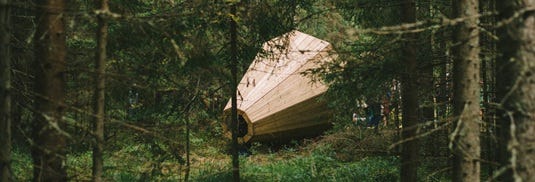
4. There is one form of intense listening for which I have all the patience in the world, and that is atmosphere—whether it’s downtown Manhattan or a dense forest. Being aware of ambient sound doesn’t come naturally unless our ears are searching for something within it.
Listening to atmosphere is optional, but since hearing it is unavoidable, one might as well pay some attention to it. In a recent BBC travel article, the author suggests recording the different soundscapes of one’s itinerary and then playing them back to relive the experience.
One of the joys of leaving one’s own quiet pad in the morning is the atmosphere waiting outside. There’s nothing specific to explain the rush one gets when the environment greets you this way, but it may be similar to hearing an analog (pre-digital) recording of a symphony: The atmosphere between the notes is an integral part of the musical experience.
Memo to digital sound engineers: Atmosphere is with the band.
Links:
Science of the hunt: https://royalsocietypublishing.org/doi/full/10.1098/rspb.2022.1164
Beauty of the hunt:
A version of this essay appeared in Three Quarks Daily
This is an excellent post, Brooks.
I admit that I have the same trouble listening to podcasts, and sometimes find I get way behind on the listening because something that was said has set my mind to thinking deeply about it. I also find I can do a better job of listening by taking notes. Of course, I am of an age when taking notes was standard practice, especially in the classroom. When I was an interviewer for a live audio program at the company I retired from, I had to listen very carefully so that I could ask follow-up questions before moving to a new question from a list of questions I had prepared. (It wasn't always easy, because most of the time I was interviewing lawyers on employment subjects or other experts whose work I had to research first.
It is fascinating, I think, to think about how we humans listen to hear, to learn, and to be distracted. I tend now to work in silence, which I prefer, after many years of being in open offices where tuning out ambient noise was essential to get any work done.
This is great, Brooks. I do have to admit that I’m one of those people who listens to podcasts while doing the dishes. In my defense, lately it’s been the Michael Silverblatt Bookworm podcast, which I recently discovered. The one place I can’t listen to podcasts (or even music) is the gym.